BriefCam’s High Availability Architecture
The following diagram presents an example of a medium-sized high availability environment.
Basic deployments include seven servers (web services, Qlik, processing, alert processing, fetching, vs server and PostgreSQL). A high availability deployment adds additional servers (marked below in yellow) for redundancy, resulting in 15 servers.
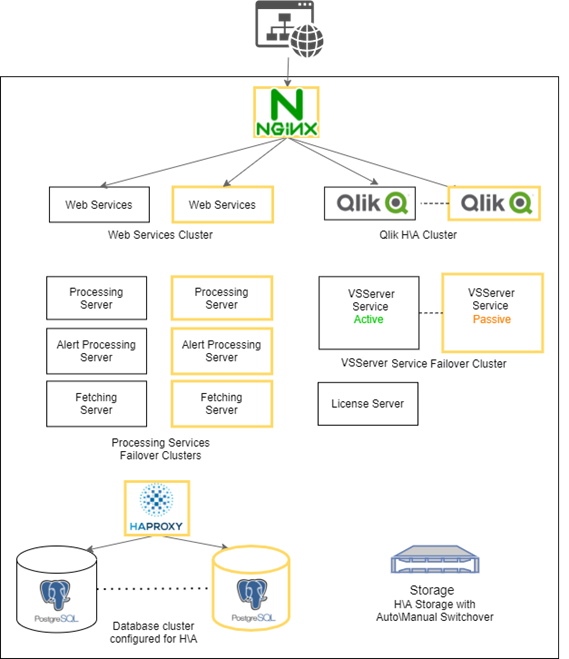
BriefCam’s High Availability solution includes two types of clustering approaches:
Active-Active – All nodes in the cluster are active. A load balancing algorithm/policy determines the preferred node for a given session. This solution increases both scalability and high availability since the redundant nodes are fully operational even when the system works in non-failure conditions.
Active-Passive – Only one node in the cluster is active at any given moment, the redundant node is waiting in standby, while the master node is being monitored. In the event of failure, a failover process (either manual or automatic) can activate the redundant node.
The next sections describe each of the sections of the diagram above in detail.
See also:
Web Services in High Availability
BriefCam’s Services in High Availability