BriefCam Next-Gen Engine Guide
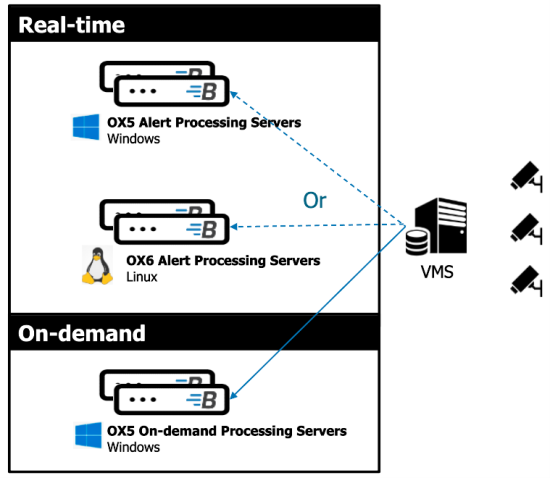
The OX6 Next-Gen engine for real-time processing, which runs on Linux, uses a state-of-the-art approach and improved technologies to provide better accuracies and new capabilities and features.
When to Use the Next-Gen Engine
The Next-Gen engine is available for distributed deployments that include all the following:
Real-time channels (RESPOND alerts and Continuous RESEARCH Sources)
VMSs listed as supported for the Next-Gen engine as detailed here: https://www.briefcam.com/partners/supported-vms/.
A separate Linux server to run the Next-Gen engine
For example, if you have a separate Linux server where you will have BriefCam’s Alert Processing Server running and you integrate with Genetec, the Next-Gen engine is the recommended choice.
If you do not have one of the three items above, you’ll continue to use the OX5 engine. For example, if you are using a non-supported VMS or only use the REVIEW module, you will use the OX5 engine.
The OX5 real-time engine cannot be used together with the OX6 real-time engine.
Benefits
The new engine provides many benefits, including:
Additional features including custom classes, group detection alerts, and crowd counting alerts.
Optimization for real-time processing, providing faster alerts. The Next-Gen engine offers Smart alerts. Smart alerts will be received within 5 seconds of the rule being triggered and will use all available filters, including four types of Count filters.
Improved real-time throughput of approximately twice the number of real-time channels compared to the OX5 engine.
The Next-Gen engine can handle low-FPS streams. (The minimum supported FPS for the Next-Gen engine is 1.5.)
Less GPUs are needed resulting in lower hardware cost of ownership, enabling more channels on existing hardware.
Enables scalability with a modular architecture.
Better detections and counting, resulting in better accuracy.
Improved accuracy in crowds and dense conditions, as well as in overhead cameras.
Better handling of static objects.
Longer dwell times. The Next-Gen engine handles static people and vehicles better than the OX5 engine. Therefore, the maximum dwell alerting time was increased to 10 minutes (instead of 2 minutes in OX5). It is recommended to only use the increased dwell time in the RESPOND module because, currently, the REVIEW module still uses the OX5 engine.
The Next-Gen engine runs on Linux, which enables reduced operating system cost.
Next-Gen Limitations
The Next-Gen engine does not have high sensitivity mode.
The Illumination Changes filter is not supported.
Bounding boxes are not supported in Next-Gen alerts.
You cannot have one rule with people counting and another rule with airplane counting on the same camera.
When using the Next-Gen engine and running rules for 24 hours, there is a one-minute gap with no processed data between tasks.
The Proximity filter is currently not available in the RESPOND module.
Geometry is currently not saved between tasks. This means that during the warmup of every new task, detailed location information is not written. Therefore, the Proximity filter cannot operate on it resulting in reduced accuracy for the Size and Speed filters.
Due to the low-FPS processing, high-speed objects across the frame may not be detected.
In full assets mode, the VIDEO SYNOPSIS and video clips are not playable in the RESPOND module.
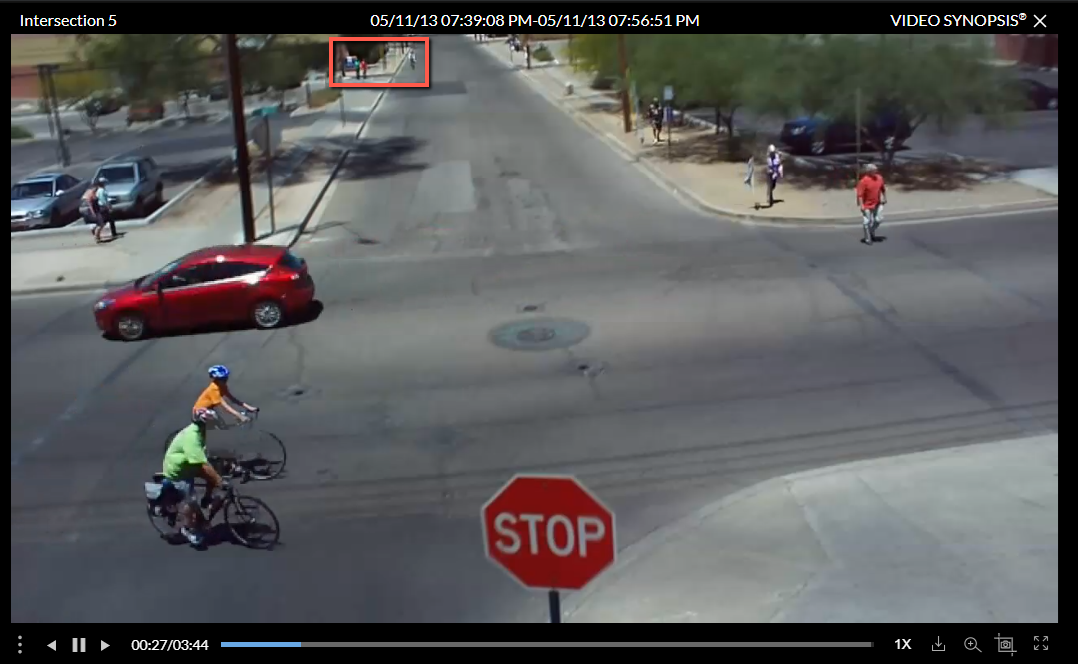
The Next-Gen engine does not handle very small objects. Small objects that are not being detected can be seen in the image below (in the red bounding boxes).