Implementation of SVQR
The use of SVQR requires at least two streams of different quality to be configured on the remote interconnected site (in the following example, the streams are referred to as low-quality and high-quality).
The high-quality stream is recorded on the remote interconnected site based on motion detection, events, schedule, or via manual control.
The low-quality stream is not recorded on the remote interconnected site, but simply relayed to the central XProtect Corporate site where it is recorded based on motion detection, events, schedule, or manual control.

When high-quality recordings are needed on the central site, for instance for conducting an investigation, the high-quality recordings can be retrieved by the users of the XProtect Smart Client, or alternatively, retrieved automatically on events.
The retrieved recordings are then stored in parallel with the existing low-quality recordings. During playback, the system will seamlessly and without user interaction switch between the low-quality and high-quality recordings. As illustrated, the client users will simply see the quality of the recordings go from low to high quality when they reach periods where high-quality recordings have been retrieved.
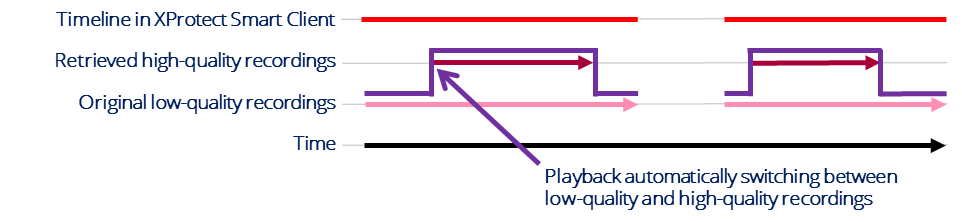
The same applies when recordings are exported. The quality of the recordings in the export will be the same as the quality experience when doing playback.
When high-quality recordings are retrieved, the existing low-quality recordings are not deleted or overwritten. The new high-quality are instead simply stored in parallel with the existing low-quality recordings. The reason for not deleting or overwriting the recordings is that it would break the digital signature of the existing recordings, making it look like the recordings had been tampered with. By placing the high-quality recordings in parallel with the existing recordings they will have their own digital signature, making it possible to verify the digital signatures of both the existing low-quality recordings and the retrieved high-quality recordings.