

Cyber threats and cyber risks
There are many sources of threats to a VMS, including business, technology, process and human attacks or failures. Threats take place over a lifecycle. The threat lifecycle, sometimes called the "cyber kill" or "cyber threat chain," was developed to describe the stages of advanced cyber threats.
Each stage in the threat lifecycle takes time. The amount of time for each stage is particular to the threat, or combination of threats, and its actors and targets.
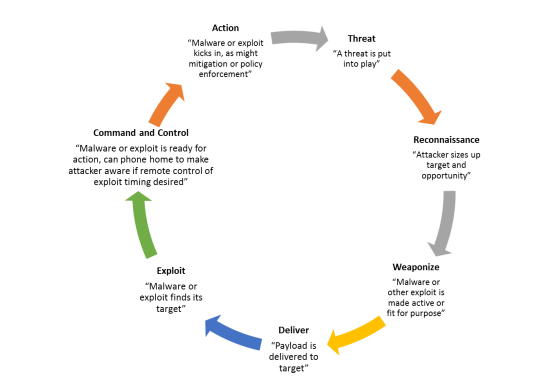
The threat lifecycle is important for risk assessment because it shows where you can mitigate threats. The goal is to reduce the number of vulnerabilities, and to address them as early as possible. For example, discouraging an attacker who is probing a system for vulnerabilities can eliminate a threat.
Hardening puts in place actions that mitigate threats for each phase in the threat lifecycle. For example, during the reconnaissance phase an attacker scans to find open ports and determine the status of services that are related to the network and the VMS. To mitigate this, hardening guidance is to close unnecessary system ports in XProtect VMS and Windows configurations.
The risk and threat assessment process includes the following steps:
- Identify information and security risks
- Assess and prioritize risks
- Implement policy, procedures, and technical solutions to mitigate these risks
The overall process of risk and threat assessment, and the implementation of security controls, is referred to as a risk management framework. This document refers to NIST security and privacy controls and other publications about risk management frameworks.
Was this article helpful?
Thanks for your feedback!